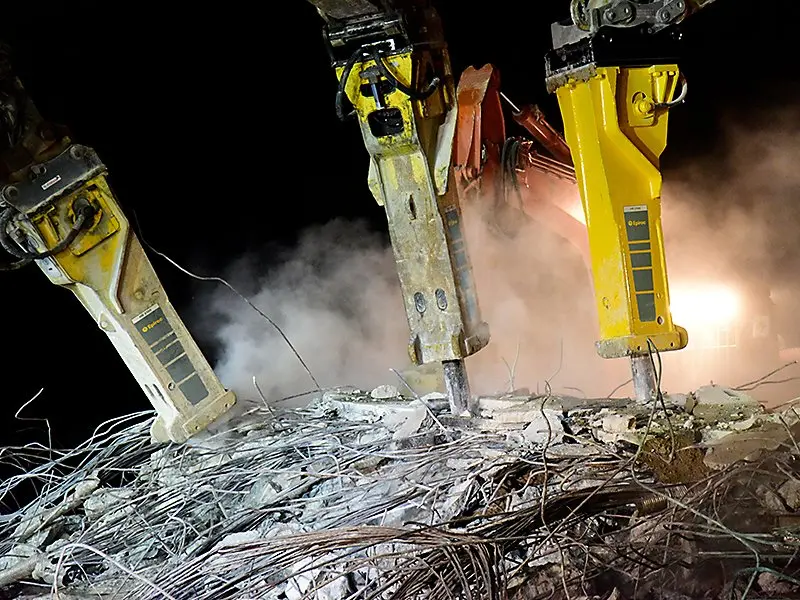
Hydraulic breakers are demolition tools widely used in earthmoving and the mining industry. They are designed to break rocks and concrete blocks of varying hardness.
Their main applications include demolition, primary excavation, trenching, and secondary rock breaking.
Hydraulic breakers can be classified into three main categories based on the size and type of excavator they are mounted on:
- Small breakers: Mainly used for excavation work, roadworks, residential demolition, and building renovation projects.
- Medium-sized breakers: Primarily used for building demolition, urban excavation, and secondary breaking in quarries.
- Large breakers: Mainly used for major demolition projects, primary quarry excavation, foundation works, tunnels, and railway tunnels.
Components and Operating Principle of Hydraulic Breakers
Hydraulic breakers consist of a hammer, a housing equipped with shock-absorbing and vibration-damping systems (which surround and protect the hammer), and a working tool (chisel).
The breaker unit can be manufactured as a single-piece unit (closed housing) or as a multi-part unit secured with four tie bolts (open housing). Inside the housing are two moving components: a piston and a valve. In addition, there is a chisel designed to strike the surface being demolished or excavated.
Hydraulic breakers must be connected to the excavator’s hydraulic system to provide driving force through high-pressure hydraulic fluid and low-pressure nitrogen stored in the accumulator head.
The energy generated by this force is then violently transferred to the top of the chisel, releasing it into the ground.
Important Routine Maintenance Procedures for Hydraulic Breakers
- The chisel must be continuously lubricated, either manually (recommended every two hours of operation) or by using an automatic lubrication system, which allows the breaker to operate without interruption.
- Shock absorbers and tie bolts (if applicable) should be inspected at the beginning and end of each work shift.
- Ensure that the chisel retaining pins and the excavator mounting bolts are properly secured.
- Make sure there are no hydraulic fluid leaks along the hoses, connections, or around the chisel.
- Perform a general inspection of the breaker to check for any weld failures, cracks in the housing, base, or chisel.